







































Why Indian Startups Are Losing Their Unicorn Status in 2026
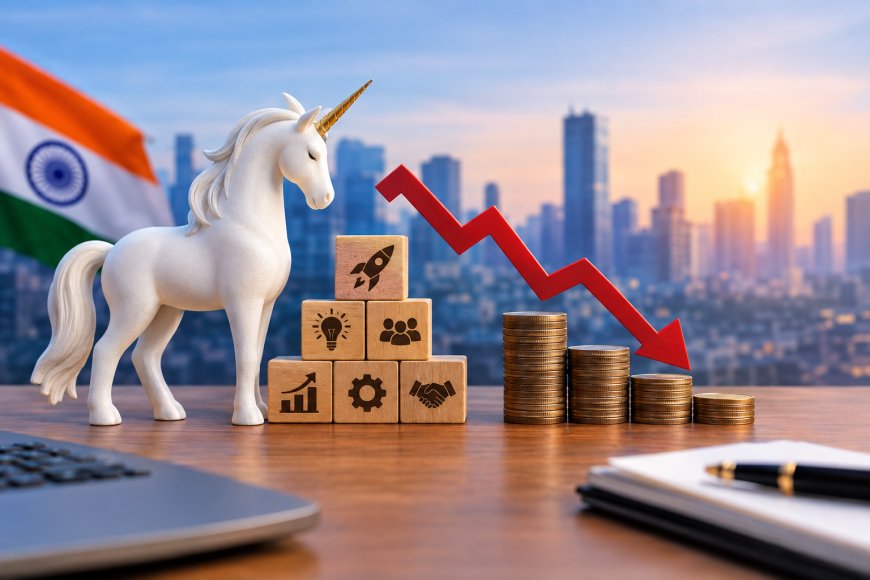
Indian startups are losing their unicorn status in 2026 as valuations reset, investors become cautious, and profitability gains importance.
By Saumya Sharma, Content Creator, BizGossips.com
For the past few years, becoming a unicorn has been one of the biggest dreams for Indian startups. A unicorn is a privately held startup valued at more than $1 billion. Reaching that mark has often been seen as proof that a company has strong potential, growing customers and investor confidence.
But in 2026, the startup story is changing.
Some Indian startups that once carried the prestigious unicorn label are now being valued below $1 billion. This shift has raised an important question: Why are Indian startups losing their unicorn status, and what does it mean for the country’s startup ecosystem?
The answer is not simply that these businesses are failing. Instead, it reflects a broader change in how investors are looking at startups.
What Does Losing Unicorn Status Mean?
Losing unicorn status simply means that a startup’s latest valuation has fallen below $1 billion. It does not automatically mean that the company has shut down or that its business is no longer valuable.
Startup valuations can change depending on funding conditions, revenue growth, profitability, investor expectations and the overall market.
During the startup funding boom, investors were willing to place very high valuations on companies based on their future growth potential. In 2026, however, investors are looking more closely at actual business performance and the path to profitability.
Why Are Indian Startups Losing Their Billion-Dollar Valuations?
Investors Are Becoming More Selective
One of the biggest changes in 2026 is investor behaviour.
Investors are no longer looking only at how quickly a startup can grow. They also want to know whether that growth can continue in a sustainable way.
Revenue, profit margins, cash burn, customer retention and the ability to generate consistent income have become much more important.
For startups that previously depended heavily on fresh funding, this tougher environment can put pressure on valuations.
The AI Boom Is Changing Investment Priorities
Artificial intelligence has become one of the biggest investment themes in the global startup ecosystem.
A significant amount of venture capital is moving toward AI companies, AI infrastructure and related technologies. As a result, startups operating in other sectors may have to work harder to attract investors.
This does not mean that Indian fintech, e-commerce or consumer startups have no future. It simply means that investors are becoming more careful about where they put their money.
The Era of Easy Valuations Is Fading
The funding boom of the previous few years created a situation where startups could sometimes raise large amounts of money at very high valuations.
That environment has changed.
Today, investors are asking more practical questions: How much revenue does the company generate? Is it profitable? How much money does it spend? Can it survive without continuously raising new capital?
As these questions become more important, some earlier valuations are being reassessed.
Is Losing Unicorn Status Really a Bad Thing?
Not necessarily.
A lower valuation can sometimes be a healthy correction. It can push founders to focus on building a stronger and more sustainable business rather than concentrating only on achieving a billion-dollar valuation.
The Indian startup ecosystem is also seeing growing interest in IPOs. Companies that want to enter the public market have to demonstrate stronger financial performance and greater transparency.
This shift could ultimately make India’s startup ecosystem healthier.
What Does 2026 Mean for Indian Founders?
The biggest lesson is simple: valuation is not the same as business value.
Being called a unicorn may create headlines, but building a company that can survive difficult markets, generate revenue and create long-term value is much more important.
Indian startups will continue to find opportunities in AI, fintech, deeptech, semiconductors, space technology and other emerging sectors. But investors are likely to remain disciplined about valuations.
For India’s founders, 2026 may therefore represent a change in mindset—from chasing the unicorn tag to building sustainable businesses.
Losing unicorn status may look disappointing on paper, but it does not necessarily mark the end of a startup’s journey. In many cases, it could simply be part of the process of becoming a stronger company.
What's Your Reaction?
 Like
0
 Dislike
0
 Love
0
 Funny
0
 Angry
0
 Sad
0
 Wow
0