





































US Suspends 8 IT Firms From Green Card Programme
The US suspends eight IT giants, including TCS, Infosys, Microsoft and Wipro, from the PERM Green Card programme, raising concerns for Indian professionals.
By Shefali Rana | BizGossips.in
The American dream just became more complicated for thousands of Indian IT professionals.
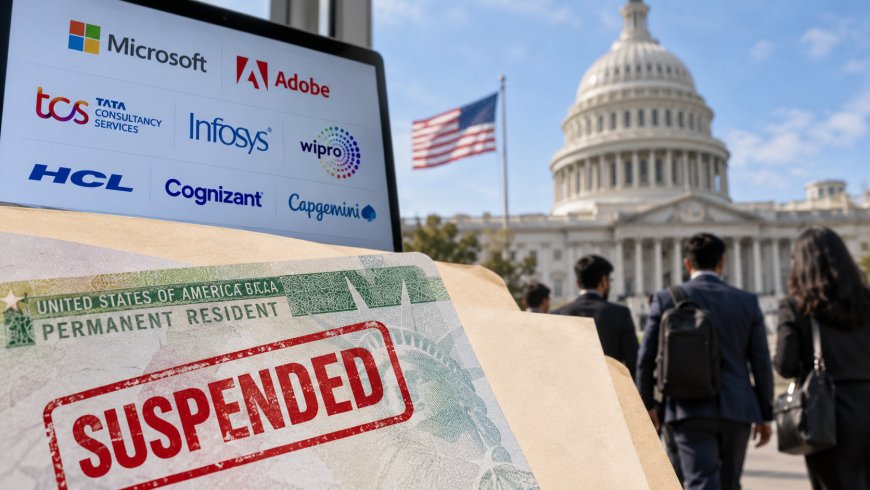
On October 8, the United States suspended eight major technology companies from a key employment-based Green Card process, putting fresh pressure on global hiring and skilled-worker immigration. The companies include Microsoft, Adobe, Tata Consultancy Services (TCS), Infosys, Wipro, HCL Technologies, Cognizant and Capgemini.
The US administration says the action is intended to protect American workers and address alleged misuse of immigration programmes. But the decision raises a difficult question: will restricting employers create more opportunities for US workers, or leave legitimate foreign professionals facing uncertainty over their future?
Why Has the US Suspended These Companies?
The US Department of Labor has stopped accepting new applications and processing pending cases under the Permanent Labor Certification programme, commonly known as PERM, involving the affected companies.
Vice President JD Vance and Labor Secretary Keith Sonderling have accused employers of exploiting employment-based immigration programmes and disadvantaging American workers. The action follows federal investigations into alleged violations. However, authorities have not publicly provided detailed, company-specific findings establishing wrongdoing by all eight firms.
That distinction matters. Investigations and allegations should not automatically be treated as proof of misconduct.
If violations are established, accountability is justified. But the broader question is whether a suspension covering multiple employers is proportionate to the evidence and how long affected workers will have to wait for clarity.
What Is PERM, and Why Does It Matter?
PERM is generally a crucial step in the employer-sponsored Green Card process for certain foreign workers.
Before sponsoring an eligible employee for permanent residency through this route, an employer typically must demonstrate that qualified US workers are not available for the relevant position under the applicable labour-certification requirements.
The suspension disrupts that process for affected employers, potentially delaying permanent-residency applications and changing the plans of employees who have spent years building careers in the US.
However, there is an important distinction: this is not a blanket ban on Indian nationals, and it does not automatically cancel existing H-1B visas or Green Cards. The immediate restriction concerns the PERM process involving the named companies.
Indian IT Professionals Could Face the Biggest Uncertainty
Indian professionals make up a substantial share of the skilled foreign workforce in the American technology industry. For employees whose permanent-residency plans depend on employer-sponsored PERM certification, the suspension could mean delayed applications, uncertainty about timelines, and difficult career decisions.
The impact will not necessarily be identical across all eight companies.
TCS, for example, has said that its PERM applications were in single digits over the previous two years and that it did not expect the action to affect its workforce strategy or customer engagements. The company has also highlighted its focus on local hiring.
That response suggests the practical consequences may vary considerably by employer and employee. Workers already far along in the immigration process may have different concerns from those who have not yet started it.
Is This Really About Protecting American Jobs?
The administration's argument is that employers should prioritise qualified American workers rather than use foreign-worker programmes in ways that undermine domestic employment or wages.
That objective is one side of the debate. The other is the role international professionals play in technology, engineering and other specialised fields.
Restricting access to employment-based immigration may change hiring incentives, but it does not automatically establish that more suitable domestic candidates are available for every affected position. The outcome depends on employers' hiring decisions, workers' skills, wage conditions and the details of the investigations.
Microsoft has pushed back against the broader criticism of its hiring practices. The company said approximately 80% of the roughly 6,000 H-1B applications it filed in the previous fiscal year involved extensions or changes of status for existing employees, rather than new hires.
The dispute therefore goes beyond immigration paperwork. It concerns how the US balances domestic employment priorities with the global competition for specialised talent.
The Bigger Question: Who Pays the Price?
For Washington, the stated goal is to protect American workers and enforce immigration rules. For affected employees, the immediate concern is much more personal: whether years of work, career planning and family decisions will be disrupted by a process they do not control.
For technology companies, the suspension also creates uncertainty around workforce planning and employee retention.
The real test will be whether the investigations produce clear findings, whether the restrictions are resolved on time, and whether legitimate applicants have a predictable path forward.
America may be tightening its approach to skilled-worker immigration, but the consequences extend beyond corporate hiring decisions. For Indian IT professionals, a job in the US may still be possible, yet the path from employment to permanent residency has become less predictable.
Disclaimer: This article is for informational purposes only and does not constitute immigration or legal advice. The situation may change as investigations and administrative proceedings develop. Individuals affected by the suspension should consult a qualified US immigration attorney about their specific circumstances.
What's Your Reaction?
 Like
0
 Dislike
0
 Love
0
 Funny
0
 Angry
0
 Sad
0
 Wow
0