





































RBI Hikes Repo Rate to 5.50%: Growth Up, But EMIs May Rise
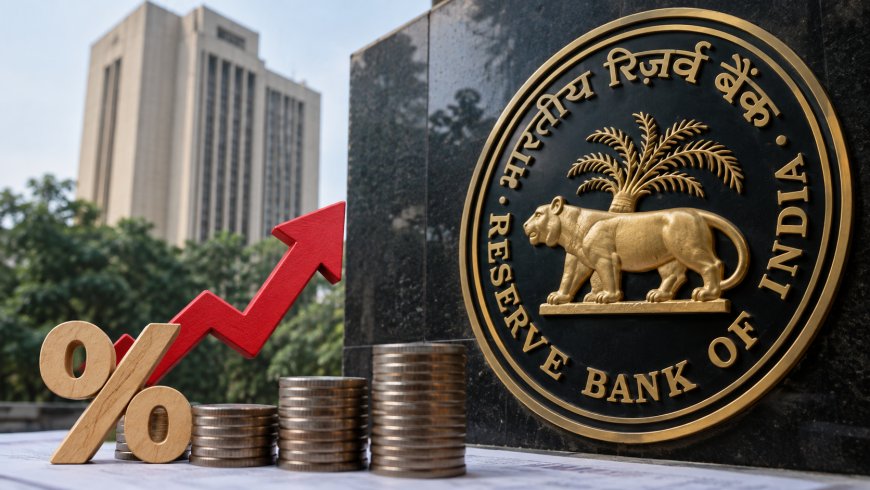
RBI raises the repo rate by 25 bps to 5.50%, lifts FY27 GDP growth forecast to 7.1% and inflation forecast to 5.2%. Here’s what it means for India.
By Shefali Rana | BizGossips.in
The Reserve Bank of India has sent a clear signal: strong economic growth does not mean cheaper money is coming back anytime soon.
On October 7, the RBI raised the repo rate by 25 basis points to 5.50%, marking its first rate hike since February 2023. The decision was unanimous, but the bigger message lies beyond the headline rate. India’s economy is growing faster than expected, yet inflation risks are forcing the central bank to put a limit on how much monetary support it is willing to provide.
And that creates a difficult balancing act.
Growth Forecast Gets a Boost
The RBI has actually become more optimistic about India’s growth outlook.
It raised its FY27 real GDP growth forecast by 40 basis points to 7.1%, while its Q2 growth estimate was upgraded to 7.2% from 6.4%.
On paper, that sounds like an economy that should comfortably absorb higher interest rates.
But the inflation picture is becoming less comfortable.
The RBI increased its FY27 inflation forecast by 20 basis points to 5.2%, suggesting that stronger economic activity is not coming without price pressures.
That is the central contradiction facing policymakers: growth is strong enough to tolerate tighter policy, but inflation is still high enough to demand it.
Inflation Is No Longer Just About Food
CPI inflation rose to 4.8% in August from 4.5% in July.
The RBI has also pointed to broader food-price pressures, including increases in items such as sugar and onions. That matters because persistent inflation can eventually spread beyond individual commodities and become harder to reverse.
The RBI has therefore shifted its stance from neutral to “calibrated tightening.”
Governor Sanjay Malhotra has indicated that rate cuts are unlikely in the near term. The next move, depending on incoming data, could therefore be another hike—or a pause.
For borrowers hoping that the previous easing cycle would eventually return, that is a very different message.
The EMI Impact Could Be Manageable—But Not for Everyone
The most immediate impact of a repo-rate hike is felt through borrowing costs.
According to a Times of India report cited in the original analysis, the EMI on a ₹1 crore home loan for 15 years could increase by roughly ₹1,500 a month at a base rate of 8.50%.
Another option for borrowers would be to keep the EMI unchanged and accept a longer repayment period, potentially adding around six instalments.
For an individual borrower, ₹1,500 may not look dramatic.
But multiply that across thousands of home loans, business loans, vehicle loans and working-capital facilities, and the impact becomes much larger.
This is where the RBI's decision becomes controversial: the same higher interest rates being used to control inflation can also make consumption and investment more expensive.
Oil and Global Risks Complicate the Picture
The RBI is also fighting forces it cannot directly control.
Renewed geopolitical tensions in West Asia have increased crude-oil volatility. Higher oil prices can feed into transportation, manufacturing and logistics costs, while also putting pressure on India's import bill and the rupee.
Global bond yields, US monetary policy and tighter financial conditions add another layer of uncertainty.
There are domestic risks too. Weak monsoon rainfall and El Niño-related weather conditions could affect agricultural production and add pressure to food prices.
In other words, the RBI is not tightening policy simply because the economy is overheating. It is also trying to protect against second-round inflation risks and external shocks.
India Still Has Some Strong Buffers
The central bank is not ignoring the other side of the equation.
India continues to benefit from strong bank-credit growth, relatively high capacity utilisation, government capital expenditure, services exports, remittances and foreign-exchange reserves.
These factors provide some protection against a sudden slowdown.
But buffers do not make higher borrowing costs irrelevant.
Businesses may delay expansion plans if financing becomes more expensive. Homebuyers may reconsider loan sizes. Consumers may become more cautious. Banks, meanwhile, have to balance credit growth against funding costs and asset quality.
The Bigger Question: How Expensive Will Growth Become?
India's growth story remains strong. But the latest RBI decision shows that growth alone is no longer enough to justify easier monetary policy.
The central bank now has to manage two competing risks: allowing inflation to become persistent or tightening too much and making economic expansion more expensive.
For households and businesses, the practical message is straightforward: do not assume the next RBI move will be a rate cut.
For investors, the bigger question is whether India's strong growth can continue to deliver robust earnings and investment without the benefit of cheaper credit.
The RBI may have put the brakes on easy money—but the real test is whether it can slow inflation without unnecessarily slowing the economy along with it.
Disclaimer: This article is for informational and analytical purposes only. It is not investment, financial, or lending advice. Interest rates, inflation, economic forecasts, and market conditions can change, and readers should conduct their own research before making financial decisions.
What's Your Reaction?
 Like
0
 Dislike
0
 Love
0
 Funny
0
 Angry
0
 Sad
0
 Wow
0