







































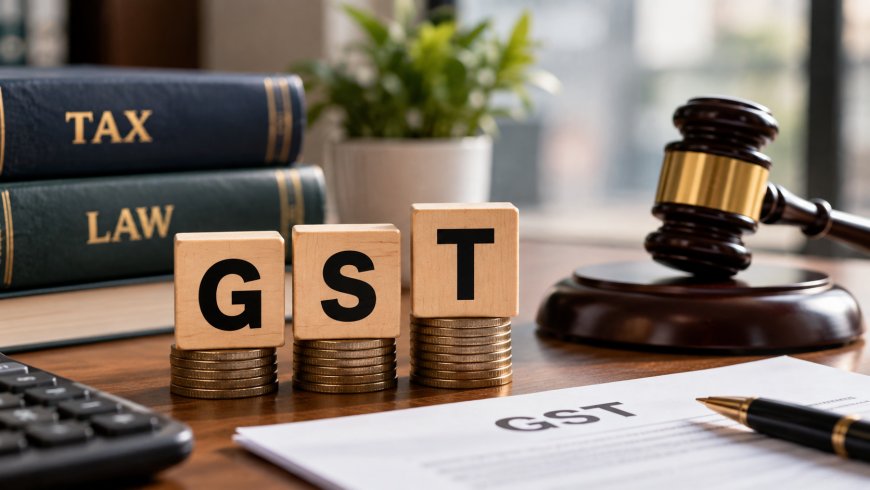
GST 2.0: Tax Officers May Lose Arrest Powers, Prosecution Limit Raised?
GST reforms may remove tax officers’ arrest powers and raise the prosecution threshold from ₹1 crore to ₹5 crore. Is this real relief for businesses?
By Shefali Rana | BizGossips.in
GST may be heading for another major rewrite, and this time the most controversial part is not a tax rate.
It is the power to arrest.
The GST Council is expected to discuss proposals on October 7 that could remove GST officers' power to arrest taxpayers and require judicial approval before an arrest. At the same time, the threshold for initiating criminal prosecution could reportedly rise from ₹1 crore to ₹5 crore.
For businesses, that could sound like welcome relief.
But a bigger question remains: is the government making GST genuinely more business-friendly, or is it acknowledging that its enforcement powers need a rethink?
From Tax Enforcement to Tax Recovery
Restricting arrest powers would not mean the government loses its ability to recover unpaid taxes.
Businesses accused of short-paying tax or wrongly claiming input tax credit (ITC) could still face recovery of tax dues, interest and penalties.
The difference is in how the dispute is treated.
Instead of allowing a tax dispute to quickly escalate into criminal action, the proposed framework would put greater emphasis on financial recovery and penalties, while serious cases involving deliberate tax evasion or fraud could continue through the criminal justice system.
For legitimate businesses, that distinction could be significant.
Tax rules can involve complex questions around classification, valuation, and ITC eligibility. A compliance dispute does not necessarily mean a business deliberately attempted to defraud the government.
The challenge will be ensuring that a softer approach does not become an easier route for genuine tax evaders.
The ₹5 Crore Prosecution Threshold Could Change the Equation
The proposed increase in the criminal prosecution threshold from ₹1 crore to ₹5 crore could become one of the most important changes.
The broad idea is to reserve criminal proceedings for larger and more serious cases, while lower-value disputes are handled through tax recovery, interest and financial penalties.
The proposal reportedly covers 24 GST-related offences.
Under the reported framework, nine offences could be removed, while 11 could remain unchanged. The minimum-punishment provision could also be removed, giving courts greater flexibility.
For offences in the middle category, the maximum sentence could reportedly fall from three years to two years.
For businesses, this could reduce the risk of relatively smaller disputes becoming criminal matters.
For the tax administration, however, the question is whether the revised framework will remain strong enough to deter deliberate fraud.
Could Technology Replace the Fear Factor?
This may be the most interesting part of the proposed reform.
When GST was introduced in 2017, the ability to identify complex networks of fake invoices and fraudulent ITC claims was more limited.
Today, the GST system has access to significantly more digital transaction and invoice data. Information reported by buyers and sellers can be compared, helping authorities identify suspicious patterns and potential fake ITC claims.
That raises an uncomfortable question:
If technology can increasingly identify suspicious transactions, does GST enforcement need to rely as heavily on arrest powers?
The answer may ultimately be a more targeted enforcement model.
Businesses need confidence that genuine mistakes will not automatically become criminal cases. At the same time, authorities need effective tools to act against deliberate evasion.
The goal should be neither weak enforcement nor excessive enforcement.
It should be better enforcement.
Next-Generation GST Has a Bigger Agenda
The proposed changes are part of a broader Next-Generation GST reform agenda focused on simplifying compliance and reducing the time and cost businesses spend dealing with the tax system.
According to Finance Minister Nirmala Sitharaman's article, taxable supplies increased 25.8% between October 2025 and July 2026 compared with the same period a year earlier.
Gross GST collections reached ₹12.46 lakh crore during April–September 2026, up 11.6% year-on-year. GST registrations also reached around 1.71 crore by August-end.
The broader reform package reportedly includes measures such as:
-
Easier GST registration
-
Faster refunds
-
Simpler ITC procedures
-
Rationalisation of penalties
-
Possible late-fee relief for smaller businesses
-
Reduced compliance and litigation burden
That suggests the government is looking beyond enforcement alone.
Relief for Businesses—or Just a Change in Enforcement?
The controversy around GST 2.0 is ultimately not about whether businesses should face penalties.
They should, when the law is deliberately violated.
The bigger issue is proportionality.
A modern tax system needs to distinguish between a genuine compliance error, a disputed interpretation, and deliberate tax fraud.
If the proposed changes create stronger judicial oversight while using technology to identify high-risk transactions, they could make GST enforcement more predictable for businesses.
But if enforcement becomes weaker without improving detection and recovery, the government could face a different problem.
A simpler GST system should not merely mean fewer punishments. It should mean fewer reasons for honest businesses to fear the system in the first place.
The October 7 GST Council meeting will be an important step in determining whether these proposals move forward.
Until then, businesses should remember one thing: these are proposals, not completed law.
Disclaimer: This article is for informational and editorial purposes only and does not constitute legal, tax, financial, or investment advice. The proposed GST changes remain subject to GST Council consideration and any required legislative process. Businesses should rely on official notifications and consult qualified tax professionals regarding their specific GST obligations.
What's Your Reaction?
 Like
0
 Dislike
0
 Love
0
 Funny
0
 Angry
0
 Sad
0
 Wow
0