




































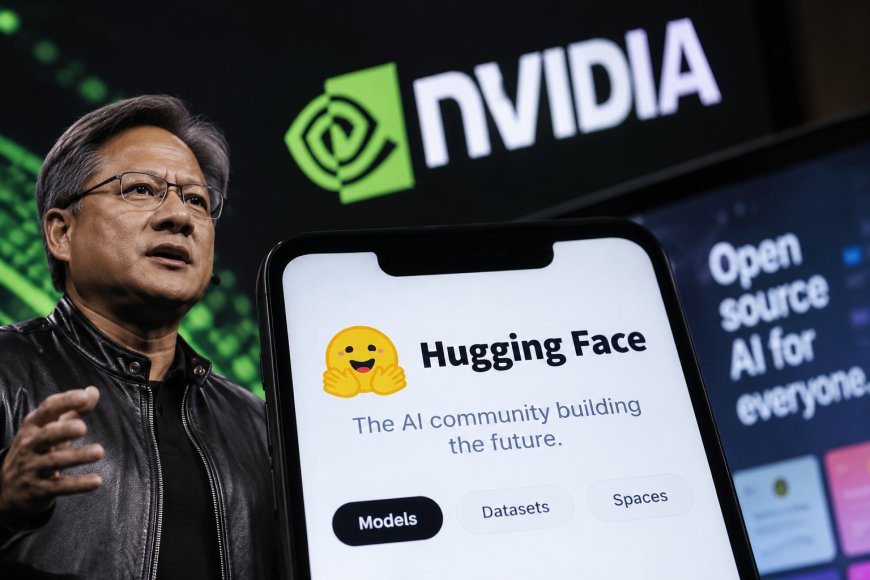
Nvidia Buys Hugging Face for $12.93 Billion: Can Open AI Stay Open?
Nvidia's $12.93 billion Hugging Face acquisition expands its AI reach beyond chips. But can an open AI platform remain neutral under Nvidia's ownership?
By Shefali Rana | BizGossips.in
Nvidia has made one of its biggest bets beyond chips — and this time, it is buying a major piece of the open AI ecosystem.
The chip giant has agreed to acquire Hugging Face for $12.93 billion, a deal that could significantly expand Nvidia's influence beyond the processors that have powered the artificial intelligence boom.
But the headline number isn't the most interesting part.
What Nvidia is actually buying may be far more important.
Hugging Face has become a major platform where developers, researchers and companies discover, share, customise and deploy AI models and tools.
According to Nvidia, more than 18 million developers, researchers and creators use the platform. Hugging Face hosts more than 3 million models, 500,000 datasets and 1 million applications, while more than 200,000 companies use the platform.
That makes this more than another AI acquisition.
Nvidia is buying a deeper position inside the community building AI.
Nvidia Says Hugging Face Will Remain Open
Nvidia appears to understand the obvious concern surrounding the deal.
If the company that dominates AI computing now owns a major platform for AI models and development, will developers still have genuine freedom to choose competing hardware?
Nvidia says they will.
The company has said Hugging Face will remain an open platform for the broader AI ecosystem. Developers will continue to be able to choose their models, frameworks, cloud providers, inference services and computing platforms.
Nvidia has also said its own hardware will not be required to build or deploy through Hugging Face. The platform is expected to continue supporting multi-cloud and multi-accelerator development.
That sounds reassuring.
But ownership inevitably changes the strategic equation.
There is currently no evidence that Nvidia plans to block rival hardware. Its stated position is actually the opposite.
Still, Nvidia will now have a direct financial interest in the ecosystem where developers decide which AI models to use and what computing infrastructure they need.
That creates a tension worth watching.
The Real Prize May Be the Developer Ecosystem
Nvidia already dominates one of the most important layers of AI: the computing infrastructure required to train and run advanced models.
But the AI industry is expanding beyond chips.
Models, agents, datasets, developer tools and deployment platforms are becoming increasingly important parts of the technology stack.
Hugging Face gives Nvidia a much stronger position in that layer.
Reuters has highlighted the broader competitive backdrop, including efforts by major technology companies such as Meta, Microsoft and OpenAI to develop their own AI chips and reduce reliance on Nvidia.
That makes the acquisition look less like a conventional software purchase and more like a strategic hedge.
Nvidia doesn't want its future to depend only on selling the chips that power AI.
It wants to be positioned closer to where the next generation of AI applications and models are actually being created.
Why Is Nvidia Paying Nearly $13 Billion?
The size of the transaction is difficult to overlook.
Nvidia says the agreed acquisition value is $12.9303 billion. Reuters reported that approximately $11.9 billion would go to Hugging Face shareholders, alongside an additional equity-based retention programme of up to $1 billion for employees joining Nvidia.
That represents a significant premium compared with Hugging Face's reported $4.5 billion valuation in 2023.
So what is Nvidia really paying for?
Technology is certainly part of the answer.
But the bigger asset could be the ecosystem surrounding that technology.
Millions of developers already use Hugging Face to experiment with models, datasets and applications. Owning the platform gives Nvidia a much closer relationship with the developers and organisations shaping how AI gets built and deployed.
As open-weight models become increasingly important, that relationship could become strategically valuable.
The Open AI Contradiction
This is where the acquisition becomes particularly interesting.
Hugging Face's appeal is closely connected to its openness. Developers can work with models from different companies and communities rather than being locked into one AI provider.
Nvidia is now buying that platform.
That creates an unusual contradiction:
One of the world's most powerful AI companies is acquiring a platform whose value partly comes from being open to everyone.
Nvidia says that openness will remain intact.
But openness isn't measured only by a company's public promises.
It can also be influenced by how quickly competing hardware is supported, how products are integrated, how models perform across different platforms and which technologies receive the deepest optimisation.
Those questions cannot be answered by the acquisition announcement.
They will become clearer only once Nvidia begins integrating Hugging Face into its wider ecosystem.
Should Competitors Be Worried?
This is where the deal deserves scrutiny.
There is a potential conflict of interest that competitors and developers will likely watch closely: Nvidia could theoretically have incentives to make its own hardware work particularly well within a platform it now owns.
Reuters has reported such concerns while also highlighting Nvidia's commitment to maintaining an open and interoperable platform.
The distinction is important.
A potential conflict of interest is not proof of wrongdoing.
Nvidia has not announced plans to restrict competing chips from Hugging Face. In fact, the company has explicitly said that other hardware will continue to be supported.
But even without deliberate restrictions, small differences in optimisation, integration or developer experience can become strategically meaningful at scale.
That is why the acquisition deserves attention without assuming an outcome that hasn't happened.
Nvidia Is Moving Further Up the AI Stack
Perhaps the biggest takeaway is that Nvidia is becoming much more than a chip company.
It already has a major presence across AI computing, software and infrastructure. Hugging Face adds another layer — the developer ecosystem surrounding AI models and applications.
And there is an interesting business logic behind that strategy.
Nvidia says it is already the largest contributor of open models and data to Hugging Face, with more than 500 models and 250 open datasets on the platform.
More open models can mean more experimentation.
More experimentation can lead to more AI deployments.
And more AI deployments ultimately require computing infrastructure.
Nvidia sells that computing infrastructure.
So, from Nvidia's perspective, supporting the growth of open AI can also strengthen demand for the computing systems at the heart of its existing business.
The Bigger AI Trend: Control Is Moving Up the Stack
The Hugging Face deal also reflects a broader shift in the AI industry.
The battle is no longer just about who makes the fastest chip.
Companies are increasingly competing across the entire AI stack — from chips and data centres to software, models, developer platforms and applications.
Nvidia's acquisition of Hugging Face potentially puts it closer to several of these layers at once.
That could give the company more influence over the direction of AI development.
It could also make questions around ecosystem neutrality more important than ever.
What Happens Next?
The acquisition has not yet been completed. Closing remains subject to customary conditions, including regulatory approvals.
The real test will begin after the transaction closes.
Will Hugging Face remain genuinely hardware-neutral?
Will developers continue to have the same freedom to choose competing chips and cloud providers?
And will Nvidia actually maintain its commitment that its own hardware will not become a requirement?
Those questions don't have definitive answers yet.
But they matter because Nvidia is no longer simply supplying the machines behind the AI revolution.
It is increasingly positioning itself around the ecosystem built on top of those machines.
BizGossips Take
The $12.93 billion Hugging Face acquisition is not just another example of Nvidia spending heavily on AI.
It is a bet on where AI value will sit in the future.
Nvidia already controls a critical part of the infrastructure layer. Hugging Face gives it a much stronger position among developers, models, datasets and applications.
Strategically, that makes sense.
But it also creates an unusual challenge.
Nvidia now has to prove that it can own a major part of the open AI ecosystem without undermining the openness that made that ecosystem valuable in the first place.
There is no evidence today that Nvidia intends to shut competitors out.
But the real measure of openness won't be the acquisition announcement.
It will be what developers are actually allowed to do after the acquisition.
And that is ultimately what will determine whether this $12.93 billion bet becomes a masterstroke — or raises uncomfortable questions about who really controls the AI ecosystem.
Disclaimer
This article is based on publicly available company disclosures and reported information. The potential risks, conflicts and strategic concerns discussed are presented as editorial analysis and should not be interpreted as allegations of wrongdoing or confirmation of any future action by Nvidia or Hugging Face. The transaction remains subject to applicable conditions and regulatory approvals.
What's Your Reaction?
 Like
0
 Dislike
0
 Love
0
 Funny
0
 Angry
0
 Sad
0
 Wow
0