









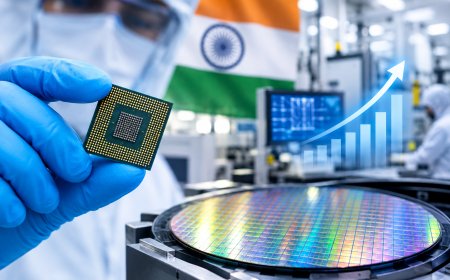































India’s Next Industrial Revolution: 6 Sectors Driving Growth
India’s next industrial revolution could be driven by six sectors: semiconductors, data centres, space, electronics, solar manufacturing and aerospace.

India could be entering a new phase of industrial growth as emerging sectors such as semiconductors, data centres, space, electronics, solar manufacturing and aerospace gain momentum.
A new report by global investment bank Jefferies identifies these six industries as important drivers of India’s next industrial revolution. Rising domestic demand, government support, private investment and India’s growing role in global supply chains are helping accelerate this shift.
Six Industries Could Lead India’s Next Growth Wave
India’s next industrial cycle is expected to be increasingly technology-driven, with new opportunities emerging across manufacturing, digital infrastructure and strategic industries.
1. Data Centres: Building Digital Infrastructure
India’s expanding digital economy is creating strong demand for data storage and computing infrastructure.
According to Jefferies, India’s data-centre capacity could increase from around 2 GW to 10 GW over the next five years, creating an investment opportunity of approximately $45 billion.
The growth is being driven by cloud computing, artificial intelligence, digital services and rising data consumption.
2. Semiconductors: Building a Chip-Making Ecosystem
Semiconductors are becoming strategically important for India as the country aims to reduce dependence on imported chips.
Investment in semiconductor projects has crossed $20 billion, with projects including Tata Electronics’ semiconductor facility and Micron’s plant in Sanand, Gujarat.
The industry supports several sectors, including automobiles, electric vehicles, telecom, consumer electronics and AI.
3. Space: A Growing Private Industry
India’s space sector is moving beyond government-led missions as private companies enter areas such as satellites, launch services and space technology.
Since private participation expanded in 2020, the sector has attracted hundreds of startups. India is also targeting a significantly larger commercial space economy, creating opportunities for technology and manufacturing companies.
4. Electronics Manufacturing: Moving Beyond Assembly
India has rapidly expanded electronics manufacturing, particularly in smartphones.
The next phase is expected to focus more on domestic component manufacturing, helping India increase value addition and strengthen its position in global supply chains.
Government initiatives are also supporting the production of electronic components and printed circuit boards.
5. Solar Manufacturing: Expanding Clean Energy
India’s renewable-energy goals are creating opportunities in domestic solar manufacturing.
The Jefferies report projects that solar manufacturing could reach around 90% localisation by 2030. Greater domestic production could strengthen India’s clean-energy supply chain and reduce import dependence.
6. Aerospace: Expanding Global Manufacturing
Aerospace is another sector gaining importance as India seeks to expand its role in global manufacturing.
India’s aerospace exports reached approximately $7 billion in FY2025, according to Jefferies. Growing global demand could create further opportunities for Indian companies in aircraft components, engineering and advanced manufacturing.
Why This Industrial Shift Matters
Together, these sectors represent a broader move towards high-technology manufacturing, digital infrastructure, clean energy and strategic industries.
India already has a strong position in IT and services. The next opportunity is to convert its technological capabilities and domestic demand into large-scale manufacturing, exports and skilled employment.
Recent investments also show growing interest in AI infrastructure and advanced manufacturing, suggesting that this industrial transition is already underway.
India’s Industrial Opportunity Is Expanding
The growth of semiconductors, data centres, space, electronics, solar and aerospace could reshape India’s industrial landscape.
The bigger opportunity may come from the supply chains developing around these sectors. Together, technology, manufacturing, infrastructure and innovation could become key pillars of India’s next industrial growth cycle.
— Jyoti | Content Creator, BizGossips.com
Disclaimer
This article is for informational purposes only and does not constitute investment, financial or business advice. Industry developments and projections are subject to change.
What's Your Reaction?
 Like
0
 Dislike
0
 Love
0
 Funny
0
 Angry
0
 Sad
0
 Wow
0