


































ITC Infotech-Happiest Minds Merger: ₹1,330 Cr Deal Explained
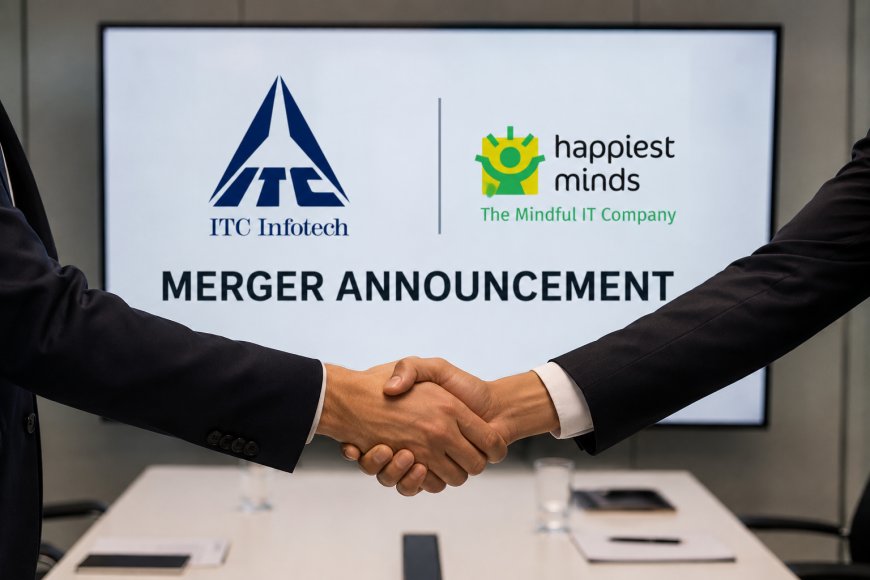
ITC Infotech to acquire 22.1% stake in Happiest Minds for ₹1,330 crore before a proposed merger. Here’s what the $1 billion AI-first IT deal means for investors.
By Shefali Rana | BizGossips.in
The Indian IT industry has just witnessed a deal that could significantly change the competitive landscape.
ITC Infotech is set to acquire a 22.1% stake in Happiest Minds Technologies for around ₹1,330 crore, followed by a proposed merger of the two companies. The combined entity is targeting US$1 billion in annual revenue by FY28, with more than 19,000 employees and over 800 customers across 30+ countries.
The strategic pitch is straightforward: combine technology capabilities, increase scale and build a stronger AI-led global technology business.
But beneath the headline numbers lies a more interesting question:
Is this really a merger of two complementary businesses—or is Happiest Minds effectively becoming part of the ITC empire?
₹1,330 Crore Acquisition Sets the Merger in Motion
ITC Infotech, a wholly owned subsidiary of ITC Ltd, will acquire the 22.1% stake from Happiest Minds promoter Ashok Soota and Ashok Soota Medical Research LLP.
The acquisition is planned in two tranches:
-
11% stake at ₹390 per share
-
11.106% stake at ₹400 per share
-
Total consideration: approximately ₹1,330 crore
However, the stake acquisition is only the first step.
Under the proposed arrangement, Happiest Minds will be amalgamated into ITC Infotech. Happiest Minds shareholders will receive 25 ITC Infotech shares for every 81 Happiest Minds shares held.
Following the proposed merger, ITC Limited is expected to own 73.4% of the combined entity, while existing Happiest Minds shareholders will hold the remaining 26.6%.
That ownership structure makes one thing clear: this is not a conventional 50:50 merger.
Why AI Is at the Centre of the Deal
The strategic reasoning behind the transaction is easier to understand when the businesses are put together.
ITC Infotech brings capabilities in areas such as cloud, data analytics, enterprise transformation, SAP, product lifecycle management and managed services.
Happiest Minds adds strengths in digital product engineering, cybersecurity, data and specialised AI capabilities.
Together, the companies believe they can pursue larger technology-transformation contracts and capture the growing demand for AI-led services.
The proposed combined business is expected to have:
-
19,000+ employees
-
800+ customers
-
Operations across 30+ countries
-
A target of US$1 billion annual revenue by FY28
-
A stronger presence in the US market
-
Greater exposure to BFSI, healthcare, Hi-Tech and EdTech
On paper, the combination looks powerful.
But scale is an opportunity, not a guarantee of growth.
The $1 Billion Revenue Target Needs Context
The headline “$1 billion AI-first technology enterprise” is undoubtedly attractive.
However, investors should remember that this is a future target on a pro-forma basis, rather than the combined company's current revenue.
The growth strategy depends on factors such as cross-selling, up-selling, winning larger transformation mandates and leveraging the complementary capabilities of both organisations.
And that's where execution becomes critical.
Combining two technology companies isn't simply a matter of putting their revenues together. Teams, customers, technology platforms and corporate cultures all have to work together.
If integration slows down the business, scale could become a burden rather than an advantage.
What Does the Deal Mean for Happiest Minds Shareholders?
For Happiest Minds investors, the transaction represents a major change.
The company they invested in as an independent technology business is expected to become part of a much larger ITC Infotech-led structure.
The proposed share-swap arrangement gives them 25 ITC Infotech shares for every 81 Happiest Minds shares, while ITC Limited will ultimately hold a controlling 73.4% stake in the combined entity.
This creates a genuine strategic trade-off.
On one side, Happiest Minds could gain access to larger enterprise customers, greater resources, broader global reach and the financial strength of the ITC group.
On the other, shareholders are giving up exposure to an independent specialist technology company.
So the question isn't simply whether the merger is good or bad.
The question is whether the benefits of scale will outweigh the value of independence.
The Listing Angle Could Be Even Bigger
There is another element that makes this transaction particularly interesting.
ITC Infotech is proposed to be listed on the BSE and NSE after the merger receives the required approvals.
That could eventually give public-market investors direct exposure to ITC's technology-services business.
In that sense, the transaction is about more than absorbing Happiest Minds.
It could also help create a separately listed, larger-scale technology-services platform backed by ITC.
That could make the eventual listed entity an important player to watch in India's IT services space.
The Deal Isn't Done Yet
Investors should also avoid treating the proposed merger as a completed transaction.
The deal remains subject to statutory, shareholder and regulatory approvals, including approvals from the Competition Commission of India, relevant stock exchanges and the National Company Law Tribunal.
The companies expect the transaction to take approximately 15 months, while the businesses will continue to operate independently until the necessary approvals are secured.
So, while the announcement is significant, execution and regulatory clearance remain important milestones.
BizGossips Take: AI Story or Scale Story?
ITC Infotech and Happiest Minds are essentially betting on a simple formula:
Scale + AI + complementary capabilities = stronger growth.
There is a strong strategic argument behind that formula. Enterprise technology spending is increasingly shifting towards AI, cloud, cybersecurity, data and digital transformation, while large customers often prefer technology partners capable of handling multiple requirements.
A combined organisation with more than 19,000 employees and 800+ customers could have significantly more firepower than either company operating separately.
But bigger doesn't automatically mean better.
The real test will be whether the combined company can turn its increased scale into sustainable and profitable growth.
The proposed US$1 billion revenue target makes for a compelling headline. Now the challenge is turning that target into reality.
For Happiest Minds shareholders, the question is even more interesting:
Are they gaining a stronger technology platform—or exchanging an independent growth story for a much larger corporate one?
The answer won't come from the merger announcement.
It will come from execution.
Disclaimer
This article is for informational and educational purposes only and does not constitute investment advice, a recommendation, or a buy/sell call. Investors should conduct their own research and consult a qualified financial adviser before making any investment decisions. The proposed transaction remains subject to applicable statutory, regulatory and shareholder approvals.
What's Your Reaction?
 Like
0
 Dislike
0
 Love
0
 Funny
0
 Angry
0
 Sad
0
 Wow
0