












































NASA Voyager 1 Goes Silent for 48 Hours: What Happened?
NASA's Voyager 1 has ceased transmission, prompting a critical inquiry into whether humanity's most distant spacecraft is finally exhausting its remaining operational lifespan.
By Shefali Rana | BizGossips.in
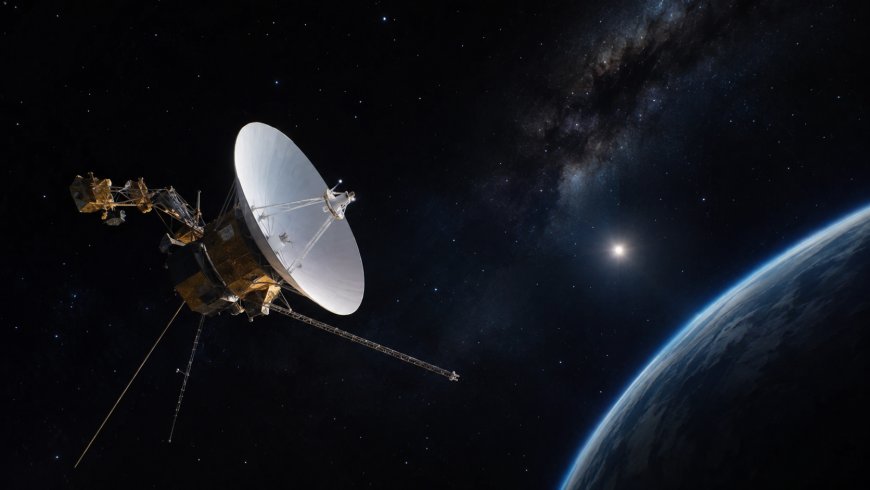
After a forty-eight-hour communications blackout, NASA's Voyager 1 has re-established contact with Earth, underscoring the formidable obstacles facing humanity's most remote probe: sustaining a mission that has endured for nearly five decades amid rapidly waning power reserves.
After a lapse in scheduled telemetry on October 18 and 19, 2026, the spacecraft's signal resumed on October 20, before the engineering team transmitted diagnostic commands.
Although uninterrupted contact has been maintained thereafter, NASA continues to investigate the root cause of the interruption.
The spacecraft remains operational and has not been categorized as lost; consequently, this incident does not portend the imminent termination of its mission.
Nevertheless, given the contraction of its power reserves and the progressive degradation of its systems, any unforeseen malfunction assumes critical significance.
What unfolded in the depths of space?
Over a span of twenty-four hours, the Deep Space Network failed to intercept radio transmissions from Voyager 1 during two consecutive scheduled contact windows.
The spacecraft resumed normal communication the subsequent day, necessitating no recovery protocols from mission engineers.
NASA's inquiry revealed that a specific cluster of thrusters had ceased operation, prompting the automatic engagement of redundant propulsion units.
This response aligns with Voyager's fault-protection protocols, which are engineered to intervene when onboard diagnostics identify emerging anomalies; such mechanisms stabilize the spacecraft to ensure operational safety while ground teams evaluate the extent of the malfunction.
Nevertheless, NASA has not verified that the thruster switch was the precipitating factor for the communication disruption; the precise cause of the interruption remains the subject of ongoing inquiry.
This episode underscores the formidable challenges inherent in commanding a spacecraft situated billions of miles from Earth.
Deprived of the ability to conduct physical inspections or execute on-site repairs, engineers are compelled to diagnose anomalies through the latency-limited telemetry and the restricted data streams transmitted by the Voyager probe.
A More Pressing Concern: Voyager 1's Power Supply is Depleting
Since its 1977 launch, Voyager 1 has relied on radioisotope thermoelectric generators to produce electricity, a system that transforms thermal energy released by the decay of plutonium into electrical power.
The available power supply experiences a consistent and relentless reduction.
According to NASA, the Voyager spacecraft dissipate roughly four watts annually, compelling engineers to navigate arduous decisions regarding which subsystems and scientific instruments must remain operational.
In September 2026, engineers concluded a power-saving maneuver designated as the «Big Bang.» This initiative involved deactivating three specific units and substituting them with more energy-efficient counterparts.
These replacements were meticulously synchronized to curtail electricity consumption while preserving the spacecraft's thermal equilibrium.
This undertaking is of paramount importance, as it holds the potential to extend the operational lifespan of Voyager 1's residual scientific instruments beyond prior projections.
Absent these power-conservation modifications, NASA had forecasted that an additional instrument would necessitate deactivation as early as the summer of 2027.
As the sole human artifacts to have ventured directly into the interstellar medium beyond the Sun's heliosphere, Voyager 1 and its sister probe, Voyager 2, represent a unique scientific frontier.
Consequently, maintaining their operational capacity transcends the mere preservation of legacy hardware; it is an imperative to safeguard an irreplaceable dataset, as no other current mission can replicate these observations from such profound distances.
On November 18, a pivotal juncture marked a significant advancement in the trajectory of human development.
On November 18, 2026, NASA anticipates that Voyager 1 will attain a monumental milestone, extending its journey to a separation of one light-day from Earth.
Consequently, the distance will approximate 16.09 billion miles, or 25.90 billion kilometres.
By definition, a light-day represents the span traversed by light over the course of twenty-four hours.
Given the vast distance involved, a radio transmission requires approximately 24 hours to reach Voyager 1, with an additional 24 hours needed for a reply to traverse the same path back, resulting in a total round-trip communication window of roughly two days.
This milestone will induce no alteration within the spacecraft or its environs; rather, its import lies in quantifying the profound distance human engineering has traversed, as well as the correspondingly diminished velocity of communication.
Propelling itself at roughly 38,000 miles per hour, Voyager 1 finds that such velocity remains insufficient to bridge the colossal expanse separating it from its destination.
Is This the Beginning of the End?
Resolution of the most recent communication disruption does not preclude ongoing scrutiny; consequently, NASA maintains command of the spacecraft, simultaneously probing the underlying incident and regulating its power systems.
However, the prospect of a protracted operational challenge is inescapable.
Annually, the reserve of accessible electrical power diminishes, while the confluence of aging infrastructure and escalating communication latency renders diagnostic efforts increasingly arduous. Consequently, engineers are compelled to determine which subsystems must be maintained and which functionalities can be relinquished to prolong the mission's duration.
Voyager 1's scientific operations lack a definitive termination date, with its operational trajectory contingent upon the integrity of its subsystems, the magnitude of residual power, and the strategic engineering directives NASA may formulate as the mission unfolds.
The Bottom Line
The transient silence emanating from Voyager 1 does not signify the imminent demise of humanity's most distant probe, but rather underscores the precarious nature of sustained exploration when a machine operates well beyond its designed operational lifespan.
The spacecraft remains in active communication, continues its voyage, and persists in advancing our comprehension of the interstellar medium.
The paramount challenge now lies in sustaining its operational integrity for the duration permitted by its finite power reserves and the inherent limitations of its aging technology.
Disclaimer: This piece serves strictly as an informational summary derived from publicly disseminated NASA communications; it is imperative to acknowledge that specific mission parameters and anticipated operational trajectories remain subject to modification as NASA's ongoing investigation unfolds.
What's Your Reaction?
 Like
0
 Dislike
0
 Love
0
 Funny
0
 Angry
0
 Sad
0
 Wow
0